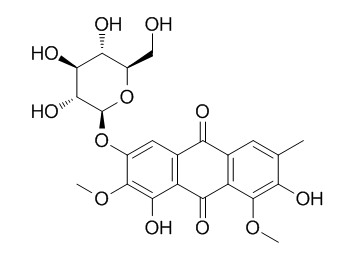
Aurantio-obtusin beta-D-glucoside
Reference standards.
Inquire / Order:
manager@chemfaces.com
Technical Inquiries:
service@chemfaces.com
Tel:
+86-27-84237783
Fax:
+86-27-84254680
Address:
1 Building, No. 83, CheCheng Rd., Wuhan Economic and Technological Development Zone, Wuhan, Hubei 430056, PRC
Providing storage is as stated on the product vial and the vial is kept tightly sealed, the product can be stored for up to
24 months(2-8C).
Wherever possible, you should prepare and use solutions on the same day. However, if you need to make up stock solutions in advance, we recommend that you store the solution as aliquots in tightly sealed vials at -20C. Generally, these will be useable for up to two weeks. Before use, and prior to opening the vial we recommend that you allow your product to equilibrate to room temperature for at least 1 hour.
Need more advice on solubility, usage and handling? Please email to: service@chemfaces.com
The packaging of the product may have turned upside down during transportation, resulting in the natural compounds adhering to the neck or cap of the vial. take the vial out of its packaging and gently shake to let the compounds fall to the bottom of the vial. for liquid products, centrifuge at 200-500 RPM to gather the liquid at the bottom of the vial. try to avoid loss or contamination during handling.
Molecules.2017, 22(3)
Turk J Med Sci.2023 53: 1312-1320.
Molecules. 2013, 18(7):7376-88
Korean J. Medicinal Crop Sci.2018, 26(2):148-156
Food Funct.2022, 13(23):12105-12120.
PLoS One.2017, 12(8):e0181191
Food Sci Nutr.2019, 8(1):246-256
Food Chem X.2024, 24:101794.
Food Chem.2019, 290:286-294
J Biochem Mol Toxicol.2020, 34(7):e22489.
Related and Featured Products
Phytochemistry. 2015 Aug;116:120-129.
Metabolic profiling of chickpea-Fusarium interaction identifies differential modulation of disease resistance pathways.[Pubmed:
25935544]
Chickpea is the third most widely grown legume in the world and mainly used as a vegetarian source of human dietary protein. Fusarium wilt, caused by Fusarium oxysporum f. sp. ciceri (Foc), is one of the major threats to global chickpea production. Host resistance is the best way to protect crops from diseases; however, in spite of using various approaches, the mechanism of Foc resistance in chickpea remains largely obscure.
METHODS AND RESULTS:
In the present study, non-targeted metabolic profiling at several time points of resistant and susceptible chickpea cultivars using high-resolution liquid chromatography-mass spectrometry was applied to better understand the mechanistic basis of wilt resistance or susceptibility. Multivariate analysis of the data (OPLS-DA) revealed discriminating metabolites in chickpea root tissue after Foc inoculation such as flavonoids, isoflavonoids, alkaloids, amino acids and sugars. Foc inoculated resistant plants had more flavonoids and isoflavonoids along with their malonyl conjugates.
Many antifungal metabolites that were induced after Foc infection viz., aurantion-obstine β-glucosides(Aurantio-obtusin beta-D-glucoside ) and querecitin were elevated in resistant cultivar.
CONCLUSIONS:
Overall, diverse genetic and biochemical mechanisms were operational in the resistant cultivar for Foc defense as compared to the susceptible plant. The resistant chickpea plants employed the above-mentioned metabolic pathways as potential defense strategy against Foc.