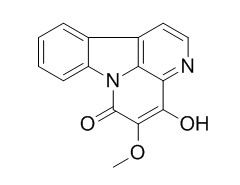
Picrasidine Q
Picrasidine Q has the capacity of anti-cell transformation and anti-cancer, it might be a chemopreventive and chemotherapeutic agent by direct targeting FGFR2 and inhibiting cell proliferation of ESCC cells.
Inquire / Order:
manager@chemfaces.com
Technical Inquiries:
service@chemfaces.com
Tel:
+86-27-84237783
Fax:
+86-27-84254680
Address:
1 Building, No. 83, CheCheng Rd., Wuhan Economic and Technological Development Zone, Wuhan, Hubei 430056, PRC
Providing storage is as stated on the product vial and the vial is kept tightly sealed, the product can be stored for up to
24 months(2-8C).
Wherever possible, you should prepare and use solutions on the same day. However, if you need to make up stock solutions in advance, we recommend that you store the solution as aliquots in tightly sealed vials at -20C. Generally, these will be useable for up to two weeks. Before use, and prior to opening the vial we recommend that you allow your product to equilibrate to room temperature for at least 1 hour.
Need more advice on solubility, usage and handling? Please email to: service@chemfaces.com
The packaging of the product may have turned upside down during transportation, resulting in the natural compounds adhering to the neck or cap of the vial. take the vial out of its packaging and gently shake to let the compounds fall to the bottom of the vial. for liquid products, centrifuge at 200-500 RPM to gather the liquid at the bottom of the vial. try to avoid loss or contamination during handling.
Prev Nutr Food Sci.2025, 30(1):92-100.
Int J Mol Sci.202, 25(17):9246.
Am J Chin Med.2023, 51(4):1019-1039.
Molecules.2024, 29(6):1392.
Front Pharmacol.2022, 13:883475.
The Japan Society for Analytical Chemistry2017, 613-617
J.Soc.Cosmet.Sci.Korea2024, 50(3): 261-270
Int. J. Mol. Sci.2022, 23(19), 11900.
Nutr Res Pract.2020, 14(5):478-489.
Nutrients.2018, 10(12):E1998
Related and Featured Products
Journal of Cellular Biochemistry, 2017, 119(2).
FGFR2 regulation by picrasidine Q inhibits the cell growth and induces apoptosis in esophageal squamous cell carcinoma.[Pubmed:
28857247]
Fibroblast growth factor receptor (FGFR) 2 and its downstream signaling cascades, PI3 K/AKT/mTOR is playing an important role in cell survival and proliferations.
METHODS AND RESULTS:
In this study, we firstly found that Picrasidine Q (PQ), an alkaloid component extracted from Angelica keiskei species, has the capacity of anti-cell transformation and anti-cancer. After ligand shape similarity approach of PQ, we found that PQ targeted FGFR 2 and verified by FGFR2 kinase assay as well as computational docking model. FGFR2 highly expressed in esophageal cancer tissues and PQ inhibited fibroblast growth factor (FGF)-induced cell transformation. Furthermore, PQ inhibited cell proliferation and induced cell cycle arrest and apoptosis in KYSE30, KYSE410, and KYSE450 esophageal squamous cell carcinoma (ESCC) cells. It was confirmed by detecting of biological markers such as cyclinD1, cyclinD3 and cyclinB1 for cell cycle or cleaved caspase-7, caspase-3, and PARP for apoptosis. PQ targeting of FGFR2 kinase activities suppressed downstream target proteins including phosphorylation of AKT and mTOR but not MEK/ERK signaling pathways.
CONCLUSIONS:
Taken together, our results are the first to identify that PQ might be a chemopreventive and chemotherapeutic agent by direct targeting FGFR2 and inhibiting cell proliferation of ESCC cells.