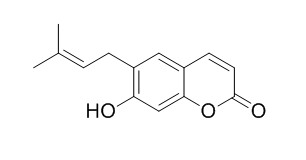
Demethylsuberosin
Demethylsuberosin has potential anti-inflammatory activity, it displays suppressive effects on LPS-induced NO and PGE2 production with the IC50 value of 9.42 uM.
Inquire / Order:
manager@chemfaces.com
Technical Inquiries:
service@chemfaces.com
Tel:
+86-27-84237783
Fax:
+86-27-84254680
Address:
1 Building, No. 83, CheCheng Rd., Wuhan Economic and Technological Development Zone, Wuhan, Hubei 430056, PRC
Providing storage is as stated on the product vial and the vial is kept tightly sealed, the product can be stored for up to
24 months(2-8C).
Wherever possible, you should prepare and use solutions on the same day. However, if you need to make up stock solutions in advance, we recommend that you store the solution as aliquots in tightly sealed vials at -20C. Generally, these will be useable for up to two weeks. Before use, and prior to opening the vial we recommend that you allow your product to equilibrate to room temperature for at least 1 hour.
Need more advice on solubility, usage and handling? Please email to: service@chemfaces.com
The packaging of the product may have turned upside down during transportation, resulting in the natural compounds adhering to the neck or cap of the vial. take the vial out of its packaging and gently shake to let the compounds fall to the bottom of the vial. for liquid products, centrifuge at 200-500 RPM to gather the liquid at the bottom of the vial. try to avoid loss or contamination during handling.
Biomed Pharmacother.2020, 131:110673.
Food Sci Nutr.2023, 00:1-10.
Applied Food Research2024, 100662.
iScience.2020, 23(2):100849.
Toxicol In Vitro.2022, 81:105346.
Planta Medica International2022, 9(01):e108-e115.
Heliyon.2023, 9(6):e16138.
Asian J Beauty Cosmetol2020, 18(3): 265-272.
J.Food Pharm.Sci.2024, 12(2), 116-124.
Biomed Pharmacother.2024, 181:117647.
Related and Featured Products
Arch Pharm Res. 2016 Feb;39(2):231-9.
Constituents of PG201 (Layla(®)), a multi-component phytopharmaceutical, with inhibitory activity on LPS-induced nitric oxide and prostaglandin E2 productions in macrophages.[Pubmed:
26306655]
Fourteen compounds, coumarin (1), Demethylsuberosin (2), xanthotoxin (3), psoralen (4), decursinol (5), decursin (6), decursinol angelate (7), chikusetsusaponin IVa (8), chikusetsusaponin IVa methyl ester (9), ethyl caffeate (10), syringaresinol (11), cnidilide (12), farnesol (13), and linoleic acid (14), were isolated from phytopharmaceutical PG201 (Layla(®)) by activity-guided fractionation utilizing inhibitory activity on nitric oxide (NO) production in vitro.
METHODS AND RESULTS:
The isolates 1-14 were evaluated for their inhibitory activity on LPS-induced NO and prostaglandin E2 (PGE2) productions in RAW 264.7 cells. All the compounds except 14 displayed suppressive effects on LPS-induced NO and PGE2 production with IC50 values ranging from 8 to 60 μM. Among these, compound 10 showed the most potent inhibitory effect on NO production from RAW 264.7 cells with an IC50 value of 8.25 μM. Compounds 2, 9, and 10 exhibited high inhibitory effects on PGE2 production with the IC50 values of 9.42, 7.51, and 6.49 μM, respectively.
CONCLUSIONS:
These findings suggest that compounds 2, 9, and 10 are the potential anti-inflammatory active constituents of PG201 and further study may be needed to explain their mechanism of action.
J Nat Prod. 2011 Oct 28;74(10):2286-9.
Structure and in vitro antiparasitic activity of constituents of Citropsis articulata root bark.[Pubmed:
21985060]
From the results of an ethnomedicinal investigation of plants from Uganda with antimalarial activity, Citropsis articulata was selected because of the antiplasmodial effect of an ethyl acetate extract of its root bark.
METHODS AND RESULTS:
Thus, from the cyclohexane, ethyl acetate, and methanol extracts, two new heterocyclic compounds, omubioside (1) and katimborine (2), were isolated in addition to five known coumarins (rutarin (3), seselin (4), suberosin (5), Demethylsuberosin (6), and haploperoside (7)), two known alkaloids (5-hydroxynoracronycine (8) and 1,5-dihydroxy-2,3-dimethoxy-10-methyl-9-acridone (9)), trigonelline (10), and the limonoid 7α-obacunyl acetate (11).
CONCLUSIONS:
The best growth inhibitors of Plasmodium falciparum were alkaloids 8 and 9, with IC50 values of 0.9 and 3.0 μg/mL.