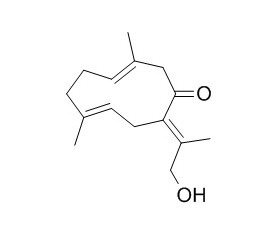
13-Hydroxygermacrone
13-Hydroxygermacrone inhibits UVB-induced upregulation of the mRNA and protein expression levels of MMP-1, MMP-2, and MMP-3 in human keratinocytes (HaCaT). 13-Hydroxygermacrone shows a protective effect against D-GalN/tumor necrosis factor-alpha-induced liver injury in mice at a dose of 50 mg/kg p.o.
Inquire / Order:
manager@chemfaces.com
Technical Inquiries:
service@chemfaces.com
Tel:
+86-27-84237783
Fax:
+86-27-84254680
Address:
1 Building, No. 83, CheCheng Rd., Wuhan Economic and Technological Development Zone, Wuhan, Hubei 430056, PRC
Providing storage is as stated on the product vial and the vial is kept tightly sealed, the product can be stored for up to
24 months(2-8C).
Wherever possible, you should prepare and use solutions on the same day. However, if you need to make up stock solutions in advance, we recommend that you store the solution as aliquots in tightly sealed vials at -20C. Generally, these will be useable for up to two weeks. Before use, and prior to opening the vial we recommend that you allow your product to equilibrate to room temperature for at least 1 hour.
Need more advice on solubility, usage and handling? Please email to: service@chemfaces.com
The packaging of the product may have turned upside down during transportation, resulting in the natural compounds adhering to the neck or cap of the vial. take the vial out of its packaging and gently shake to let the compounds fall to the bottom of the vial. for liquid products, centrifuge at 200-500 RPM to gather the liquid at the bottom of the vial. try to avoid loss or contamination during handling.
Biomed Pharmacother.2024, 175:116770.
Appl. Sci.2021, 11(19),9343.
Plant Cell Tiss Org2017, 479-486
Food Research2021, 5(1):65-71
Separations2023, 10(11), 567;
Revista Brasileira de Farmacognosia2024, 34:1091-1100.
iScience.2020, 23(2):100849.
Nutrients.2018, 10(7)
J Ethnopharmacol.2020, 249:112396
Korean J Pain.2021, 34(4):405-416.
Related and Featured Products
Arch Pharm Res. 2015 Oct;38(10):1752-60.
Germacrane sesquiterpenes isolated from the rhizome of Curcuma xanthorrhiza Roxb. inhibit UVB-induced upregulation of MMP-1, -2, and -3 expression in human keratinocytes.[Pubmed:
25471012]
METHODS AND RESULTS:
Four sesquiterpenes were isolated from the rhizome of Curcuma xanthorrhiza Roxb.: furanodiene (1), germacrone (2), furanodienone (3), and 13-Hydroxygermacrone (4). Importantly, this was the first time compounds 1 and 13-Hydroxygermacrone were isolated from this plant. The chemical structures of these compounds were determined using 1D- and 2D-nuclear magnetic resonance, infrared spectroscopy, and electron ionization mass spectrometry analyses.
CONCLUSIONS:
Among the isolated compounds, compounds 2 and 13-Hydroxygermacrone inhibited UVB-induced upregulation of the mRNA and protein expression levels of MMP-1, MMP-2, and MMP-3 in human keratinocytes (HaCaT). Moreover, this upregulation occurred in a dose-dependent manner over the range of 1-10 μM for each compound.
Nat Prod Res. 2006 Jun;20(7):680-5.
Anti-inflammatory sesquiterpenes from Curcuma zedoaria.[Pubmed:
16901812]
METHODS AND RESULTS:
From the methanolic extract of the rhizome of Curcuma zedoaria, we isolated anti-inflammatory sesquiterpene furanodiene (1) and furanodienone (2) along with new sesquiterpene compound 3 and known eight sesquiterpenes, zederone (4), curzerenone (5), curzeone (6), germacrone (7), 13-Hydroxygermacrone (8), dehydrocurdione (9), curcumenone (10), and zedoaronediol (11). Their structures were elucidated on the basis of spectroscopic data. The anti-inflammatory effect of isolated components on 12-O-tetradecanoylphorbol-13-acetate (TPA)-induced inflammation of mouse ears were examined.
CONCLUSIONS:
Compounds 1 and 2 suppressed the TPA-induced inflammation of mouse ears by 75% and 53%, respectively, at a dose of 1.0 micromol. Their activities are comparable to that of indomethacin, the normally used anti-inflammatory agent.
Biol Pharm Bull. 2002 May;25(5):627-31.
Medicinal foodstuffs. XXIX. Potent protective effects of sesquiterpenes and curcumin from Zedoariae Rhizoma on liver injury induced by D-galactosamine/lipopolysaccharide or tumor necrosis factor-alpha.[Pubmed:
12033504]
The 80% aqueous acetone extract of Zedoariae Rhizoma was found to show a protective effect against D-galactosamine (D-GalN)/lipopolysaccharide-induced acute liver injury in mice.
METHODS AND RESULTS:
To clarify the active compounds, the principal constituents were examined and 11 sesquiterpenes (furanodiene, curdione, neocurdrione, dehydrocurdione, germacrone, 13-Hydroxygermacrone, curcumenol, isocurcumenol, aerugidiol, zedoarondiol, and curcumenone) and a diarylheptanoid (curcumin) were found to inhibit the increase in serum aspartate aminotransaminase and alanine aminotransaminase at a dose of 50 mg/kg p.o. in agreement with the previous in vitro studies, except for dehydrocurdione, aerugidiol, and zedoarondiol. In particular, curdione, neocurdione, curcumenol, and isocurcumenol potently inhibited the increase at a dose of 12.5 mg/kg p.o. Furthermore, the eight sesquiterpenes, furanodiene, curdione, neocurdione, dehydrocurdione, germacrone, 13-Hydroxygermacrone, curcumenol, and curcumenone, also showed a protective effect against D-GalN/tumor necrosis factor-alpha-induced liver injury in mice at a dose of 50 mg/kg p.o.