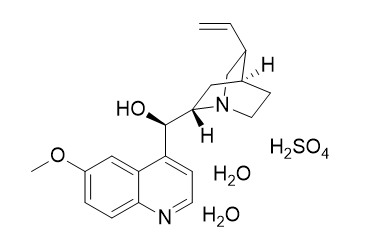
Quinine sulfate dihydrate
Quinine sulfate: a pharmaceutical product as effective corrosion inhibitor for carbon steel in hydrochloric acid solution.
Inquire / Order:
manager@chemfaces.com
Technical Inquiries:
service@chemfaces.com
Tel:
+86-27-84237783
Fax:
+86-27-84254680
Address:
1 Building, No. 83, CheCheng Rd., Wuhan Economic and Technological Development Zone, Wuhan, Hubei 430056, PRC
Providing storage is as stated on the product vial and the vial is kept tightly sealed, the product can be stored for up to
24 months(2-8C).
Wherever possible, you should prepare and use solutions on the same day. However, if you need to make up stock solutions in advance, we recommend that you store the solution as aliquots in tightly sealed vials at -20C. Generally, these will be useable for up to two weeks. Before use, and prior to opening the vial we recommend that you allow your product to equilibrate to room temperature for at least 1 hour.
Need more advice on solubility, usage and handling? Please email to: service@chemfaces.com
The packaging of the product may have turned upside down during transportation, resulting in the natural compounds adhering to the neck or cap of the vial. take the vial out of its packaging and gently shake to let the compounds fall to the bottom of the vial. for liquid products, centrifuge at 200-500 RPM to gather the liquid at the bottom of the vial. try to avoid loss or contamination during handling.
Biosci Biotechnol Biochem.2020, 84(3):621-632
Planta Med.2023, a-2192-2281.
Antioxidants (Basel).2023, 12(12):2131.
J of Apicultural Research2020, 10.1080
Virus Res.2023, 335:199199.
SRM Institute of Sci&Tech2022, 34(1): 32-37
Foods.2023, 12(6):1227.
Current Analytical Chemistry2024, 20(8):599-610.
Environ Toxicol.2024, 39(5):2927-2936.
J Cell Biochem.2018, 119(2):2231-2239
Related and Featured Products
Central European Journal of Chemistry, 2014, 12(9):901-908.
Quinine sulfate: a pharmaceutical product as effective corrosion inhibitor for carbon steel in hydrochloric acid solution.[Reference:
WebLink]
METHODS AND RESULTS:
Quinine sulfate dihydrate (QNS), IUPAC name: (8S,9R)-6-methoxy-4-quinolenyl-5-vinyl-2-quinuclidinyl methanol sulfate dihydrate, was tested as corrosion inhibitor for carbon steel in 1.5 mol L−1 HCl solution using the potentiodynamic polarization and the electrochemical impedance spectroscopy (EIS) associated with UV-Vis spectrophotometry. The electrochemical results showed that, the inhibition efficiency (IE) increased with the increase in QNS concentration, reaching a maximum value of 93.35±0.25%. The polarization resistance (R p) followed the same trend, obtaining the highest value of 659.7 Ω cm2, while the corrosion current density (i corr) reached the lowest level of 195 µA cm−2. The action mechanism of QNS was proposed considering the ability of quinine (QN) to be adsorbed on the metal surface via the lone pairs of electrons from hydroxyl oxygen atom, and/or from quinoline and quinuclidinic nitrogens. The occurrence of the complexes between inhibitor and iron ions was considered an additional process, which may contribute to protective layer formation. The Temkin adsorption isotherm was found as the best fitting for the degree of surface coverage (θ) values.
CONCLUSIONS:
In order to elucidate the mechanism of protective layer formation, the free energy of adsorption (ΔG o ads) value was calculated. This indicates that the inhibitor acts by chemical adsorption on the steel surface.