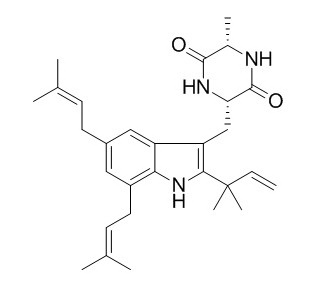
Echinulin
Echinulin has toxicity in rabbits.
Inquire / Order:
manager@chemfaces.com
Technical Inquiries:
service@chemfaces.com
Tel:
+86-27-84237783
Fax:
+86-27-84254680
Address:
1 Building, No. 83, CheCheng Rd., Wuhan Economic and Technological Development Zone, Wuhan, Hubei 430056, PRC
Providing storage is as stated on the product vial and the vial is kept tightly sealed, the product can be stored for up to
24 months(2-8C).
Wherever possible, you should prepare and use solutions on the same day. However, if you need to make up stock solutions in advance, we recommend that you store the solution as aliquots in tightly sealed vials at -20C. Generally, these will be useable for up to two weeks. Before use, and prior to opening the vial we recommend that you allow your product to equilibrate to room temperature for at least 1 hour.
Need more advice on solubility, usage and handling? Please email to: service@chemfaces.com
The packaging of the product may have turned upside down during transportation, resulting in the natural compounds adhering to the neck or cap of the vial. take the vial out of its packaging and gently shake to let the compounds fall to the bottom of the vial. for liquid products, centrifuge at 200-500 RPM to gather the liquid at the bottom of the vial. try to avoid loss or contamination during handling.
Phytochemistry Letters2015, 243-247
Eur J Pharmacol.2024, 981:176883.
Plant Cell Physiol.2023, 64(7):716-728.
Oncol Rep.2019, 41(4):2453-2463
Plant Archives2020, 2(1),2929-2934
The Pharmaceutical Society of Japan2018, 138(4):571-579
Molecules.2020, 25(15):3353.
RSC Adv.2024, 14(40):29319-29329.
Food Bioscience2023, 59:103903
J Ethnopharmacol.2017, 197:157-164
Related and Featured Products
Appl Environ Microbiol. 1988 Mar;54(3):830-1.
Eurotium spp. and echinulin in feed refused by swine.[Pubmed:
3377495]
METHODS AND RESULTS:
Feed refused by swine contained a high-propagule density of Eurotium chevalieri Mangin (anamorph, Aspergillus chevalieri (Mangin) Thom and Church), Eurotium amstelodami Mangin (anamorph, Aspergillus amstelodami (Mangin Thom and Church), and Aspergillus candidus Link. Echinulin (8 micrograms/g of feed) was detected in the feed. Isolates of E. chevalieri and E. amstelodami but not A. candidus produced Echinulin on rice or cracked corn.
CONCLUSIONS:
Mice refused to drink water containing 90 micrograms of Echinulin per ml. This is the first report of the alkaloid Echinulin in feed refused by swine.
Toxicol Lett. 1989 Sep;48(3):235-41.
Toxicity of echinulin from Aspergillus chevalieri in rabbits.[Pubmed:
2781591]
METHODS AND RESULTS:
Rabbits were injected intraperitoneally with purified Echinulin, a product of Aspergillus chevalieri.
After 2 h, the rabbits were bled and enzyme analyses were carried out on the supernates of liver homogenates and citrated plasma. Elevated levels of total plasma lactate dehydrogenase, cardiac derived isozyme, glutamic-oxaloacetic and glutamic-pyruvic transaminase activities in animals receiving toxin were observed. These levels were statistically significant compared to the vehicle control.
A significant increase in liver lactate dehydrogenase of toxin-treated rabbits was also observed.
CONCLUSIONS:
Light-microscopic examination of lung and liver showed a significant degree of damage. The increase in plasma enzyme levels is indicative of damage to these organs.