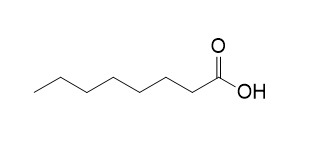
Octanoic acid
Octanoic acid is toxic for many insect species.
Inquire / Order:
manager@chemfaces.com
Technical Inquiries:
service@chemfaces.com
Tel:
+86-27-84237783
Fax:
+86-27-84254680
Address:
1 Building, No. 83, CheCheng Rd., Wuhan Economic and Technological Development Zone, Wuhan, Hubei 430056, PRC
Providing storage is as stated on the product vial and the vial is kept tightly sealed, the product can be stored for up to
24 months(2-8C).
Wherever possible, you should prepare and use solutions on the same day. However, if you need to make up stock solutions in advance, we recommend that you store the solution as aliquots in tightly sealed vials at -20C. Generally, these will be useable for up to two weeks. Before use, and prior to opening the vial we recommend that you allow your product to equilibrate to room temperature for at least 1 hour.
Need more advice on solubility, usage and handling? Please email to: service@chemfaces.com
The packaging of the product may have turned upside down during transportation, resulting in the natural compounds adhering to the neck or cap of the vial. take the vial out of its packaging and gently shake to let the compounds fall to the bottom of the vial. for liquid products, centrifuge at 200-500 RPM to gather the liquid at the bottom of the vial. try to avoid loss or contamination during handling.
Nat Prod Sci.2018, 24(3):206
J Cell Mol Med.2023, 27(10):1423-1435.
Molecules.2020, 25(23):5636.
Chemistry of Natural Compounds2018, 54(3):572-576
Agriculture2024, 14(12), 2301
CZECH MYCOLOGY2021, 73(1):1-19.
J Ethnopharmacol.2017, 209:305-316
Revista Brasileira de Farmacognosia2024, 34:1276-1286.
Anal Bioanal Chem.2023, 415(9):1641-1655.
Neurotox Res.2022, 40(6):1937-1947.
Related and Featured Products
Plant Growth Regulation, 1996, 19(3):197-201.
The effect of ethylene, octanoic acid and a plant-derived smoke extract on the germination of light-sensitive lettuce seeds.[Reference:
WebLink]
The effects of an aqueous plant-derived smoke extract, Octanoic acid and ethylene on germination of light-sensitive Grand Rapids lettuce seeds were investigated.
METHODS AND RESULTS:
The smoke extract brought about a concentration dependent increase in germination and a complete inhibition of germination at high concentrations. Octanoic acid could not induce germination. Ethylene at concentrations over 5 L L–1 increased lettuce seed germination, but not to the same degree as smoke. Aqueous smoke in combination with ethylene showed a synergistic effect on germination at suboptimal smoke concentrations. At high smoke concentrations the effect of ethylene was almost completely inhibited. Octanoic acid in combination with ethylene brought about a higher level of germination than with ethylene alone, but only at the highest concentration of Octanoic acid tested (1 mM). Standardized hexane and dichloromethane-partitioned smoke extracts and Octanoic acid were subjected to TLC separation. The R f -fractions in the smoke lanes showing activity in the lettuce seed bioassay did not correspond to the R f -value of Octanoic acid. As aqueous smoke can withstand autoclaving and can be separated by TLC and HPLC without loosing activity it is unlikely that the activity of aqueous smoke is linked to ethylene.
CONCLUSIONS:
It thus appears that the active compound in smoke is neither Octanoic acid nor ethylene.
Pesticide Biochemistry and Physiology, 1999, 65(2):90-101.
The Relation between Structures and Toxicity of Oxygenated Aliphatic Compounds Homologous to the Insecticide Octanoic Acid and the Chemotaxis of Two Species of Drosophila.[Reference:
WebLink]
Octanoic acid is the main toxic compound for Drosophila melanogaster of the fruit of Morinda citrifolia, the host plant of Drosophila sechellia. It is known that Octanoic acid is toxic for many insect species.
METHODS AND RESULTS:
The possible relation between structure and toxic activity was compared in both species. Among fatty acids with 4 to 10 carbons, a stronger toxicity of the 8-carbon chain length was observed for D. melanogaster flies. Aldehydes and ethylic esters are much less toxic than the corresponding acids. Alcohols with similar chain lengths are also highly toxic but with similar LD50 values for both species. The structure-activity studies together with species differences suggest two different toxicity mechanisms. One of these is linked to the role of Octanoic acid, for which the D. melanogaster strain Indifferent, mutant for its atypical nonrepulsion by nonanol, shows resistance comparable to that of D. sechellia.
CONCLUSIONS:
Two other behaviors were shown to be modulated by Octanoic acid and in a species-different way: oviposition and chemotaxis. The oviposition of fertilized D. melanogaster females is inhibited, while that of D. sechellia is stimulated and in a quantitatively similar way. Hexanoic acid induces a similar, strong, stimulating effect on the egg laying of D. sechellia but only weak inhibition in D. melanogaster. Both acids also attract D. sechellia and repel D. melanogaster females. Behavioral data are discussed together with genetic information.