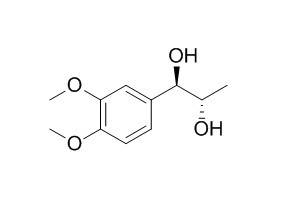
1-(3,4-Dimethoxyphenyl)propane-1,2-diol
Standard reference
Inquire / Order:
manager@chemfaces.com
Technical Inquiries:
service@chemfaces.com
Tel:
+86-27-84237783
Fax:
+86-27-84254680
Address:
1 Building, No. 83, CheCheng Rd., Wuhan Economic and Technological Development Zone, Wuhan, Hubei 430056, PRC
Providing storage is as stated on the product vial and the vial is kept tightly sealed, the product can be stored for up to
24 months(2-8C).
Wherever possible, you should prepare and use solutions on the same day. However, if you need to make up stock solutions in advance, we recommend that you store the solution as aliquots in tightly sealed vials at -20C. Generally, these will be useable for up to two weeks. Before use, and prior to opening the vial we recommend that you allow your product to equilibrate to room temperature for at least 1 hour.
Need more advice on solubility, usage and handling? Please email to: service@chemfaces.com
The packaging of the product may have turned upside down during transportation, resulting in the natural compounds adhering to the neck or cap of the vial. take the vial out of its packaging and gently shake to let the compounds fall to the bottom of the vial. for liquid products, centrifuge at 200-500 RPM to gather the liquid at the bottom of the vial. try to avoid loss or contamination during handling.
Hindawi J of Food Biochemistry2023, P17:8883860
Vietnam J. Chemistry2022, 60(2):211-222
The Malaysian journal of pathology2019, 41(3):243-251
Tea Res. Ins. Of China2017, 1-12
Int J Biol Macromol.2018, 112:1093-1103
Journal of Analytical Chemistry2017, 854-861
Research on Crops.2017, 18(3):569
Egyptian Pharmaceutical Journal2024, epj_205_23.
Evidence-based Compl.&Alternative Med.2023, 5417813
Int J Mol Sci.2022, 23(23):14545.
Related and Featured Products
Journal of Molecular Catalysis B: Enzymatic.2000 Feb;8(4-6):213–219.
Laccase-catalyzed oxidation of 1-(3,4-dimethoxyphenyl)-1-propene using ABTS as mediator.[Reference:
WebLink]
METHODS AND RESULTS:
The fungal laccases catalyzed oxidation of 1-(3,4-dimethoxyphenyl)-1-propene (2) with dioxygen in acetate buffer (pH 4.5) producing 1-(3,4-Dimethoxyphenyl)propane-1,2-diol (4) and its 1-O-acetyl and 2-O-acetyl derivatives 5 and 6, and 3,4-dimethoxybenzaldehyde (7). However, in phosphate buffer (pH 5.9), the same reaction produced only 1-(3,4-Dimethoxyphenyl)propane-1,2-diol and 7.
CONCLUSIONS:
When 1-(3,4-Dimethoxyphenyl)propane-1,2-diol was treated in the same fashion in the phosphate buffer, it was converted into 7 with more than 95 mol% yield.