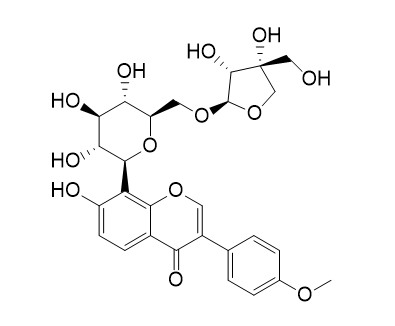
Formononetin-8-C-beta-D-apiofuranosyl-(1->6)-O-beta-D-glucopyranoside
Reference standards.
Inquire / Order:
manager@chemfaces.com
Technical Inquiries:
service@chemfaces.com
Tel:
+86-27-84237783
Fax:
+86-27-84254680
Address:
1 Building, No. 83, CheCheng Rd., Wuhan Economic and Technological Development Zone, Wuhan, Hubei 430056, PRC
Providing storage is as stated on the product vial and the vial is kept tightly sealed, the product can be stored for up to
24 months(2-8C).
Wherever possible, you should prepare and use solutions on the same day. However, if you need to make up stock solutions in advance, we recommend that you store the solution as aliquots in tightly sealed vials at -20C. Generally, these will be useable for up to two weeks. Before use, and prior to opening the vial we recommend that you allow your product to equilibrate to room temperature for at least 1 hour.
Need more advice on solubility, usage and handling? Please email to: service@chemfaces.com
The packaging of the product may have turned upside down during transportation, resulting in the natural compounds adhering to the neck or cap of the vial. take the vial out of its packaging and gently shake to let the compounds fall to the bottom of the vial. for liquid products, centrifuge at 200-500 RPM to gather the liquid at the bottom of the vial. try to avoid loss or contamination during handling.
Front Cell Infect Microbiol.2018, 8:292
Srinagarind Medical Journal2017, 32(1)
Cell Death Dis.2019, 10(12):882
Front Immunol.2020, 11:598556.
Turkish Journal of Pharmaceutical Sciences2022, DOI: 10.4274
J Cell Mol Med . 2023, jcmm.17954.
Molecules.2019, 24(16):E2985
Sains Malaysiana2024, 53(4):795-805
Sci Rep.2020, 10:4495(2020)
Biomedicines.2021, 9(8):996.
Related and Featured Products
China journal of Chinese materia medica, 2017, 42(16):3206-3212.
Absorption and transport of isoflavonoid compounds from Tongmai formula across human intestinal epithelial (Caco-2) cells in vitro.[Pubmed:
29171242]
Tongmai formula (TMF) is a drug combination of three components including Puerariae Lobatae Radix [roots of Pueraria lobata], Salviae Miltiorrhizae Radix (roots of Salvia miltiorrhiza) and Chuanxiong Rhizoma (rhizomes of Ligusticum chuanxiong) in a weight ratio of 1∶1∶1.
METHODS AND RESULTS:
The absorption and transport of isoflavonoid compounds from Tongmai formula across human intestinal epithelial (Caco-2) cells in vitro were studied in this paper. The assay isoflavonoid compounds include daidzein, formononetin, 5-hydroxylononin, ononin, daidzin, 3'-methoxypuerarin, genistin, puerarin,
formononetin-8-C-β-D-apiofuranosyl-(1→6)-O-β-D-glucopyranoside(Formononetin-8-C-beta-D-apiofuranosyl-(1->6)-O-beta-D-glucopyranoside), formononetin-7-O-β-D-apiofuranosyl-(1→6)-O-β-D-glucopyranoside, lanceolarin, kakkanin, daidzein-7,4'-di-O-β-D-glucopyranoside, mirificin, 3'-hydroxypuerarin, 3'-methoxydaidzin, formononetin-8-C-β-D-xylopyranosyl-(1→6)-O-β-D-glucopyranoside, genistein-8-C-β-D-apiofuranosyl-(1→6)-O-β-D-glucopyranoside, genistein-7-O-β-D-apiofuranosyl-(1→6)-O-β-D-glucopyranoside (ambocin), 3'-hydroxymirificin, 6″-O-β-D-xylosylpuerarin, biochanin A-8-C-β-D-apiofuranosyl-(1→6)-O-β-D-glucopyranoside, 3'-methoxydaidzein-7,4'-di-O-β-D-glucopyranoside, daidzein-7-O-β-D-glucopyranosyl-(1→4)-O-β-D-glucopyranoside, and daidzein-7-O-α-D-glucopyranosyl-(1→4)-O-β-D-glucopyranoside. By using human Caco-2 monolayer as an intestinal epithelial cell model in vitro, the permeability of above-mentioned 25 isoflavonoids in TMF were studied from the apical (AP) side to basolateral (BL) side or from the BL side to AP side. The assay compounds were determined by reversed phased high-performance liquid chromatography (HPLC) coupled with UV detector. Transport parameters and apparent permeability coefficients (Papp) were then calculated and and compared with those of propranolol and atenolol, which are the transcellular transport marker and as a control substance for high and poor permeability, respectively. The Papp values of daidzein and formononetin were (2.55±0.03) ×10⁻⁵,(3.06±0.01) ×10⁻⁵ cm•s⁻¹ from AP side to BL side, respectively, and (2.62±0.00) ×10⁻⁵, (2.65±0.11) ×10⁻⁵ cm•s⁻¹ from BL side to AP side, respectively. Under the condition of this experiment, the Papp value was (2.66±0.32) ×10⁻⁵ cm•s⁻¹ for propranolol and (2.34±0.10) ×10⁻⁷ cm•s⁻¹ for atenolol. The Papp values of daidzein and formononetin were at a same magnitude with those of propranolol. And the Papp values of other 23 isoflavonoid compounds were at a same magnitude with those of atenolol. On the other hand, the rats of Papp AP→BL/Papp BL→AP of daidzein and formononetin on the influx transport were 0.97 and 1.15, respectively. It can be predicted that daidzein and formononetin can be absorbed across intestinal epithelial cells to go to the body circulation by the passive diffusion mechanism and they were assigned to the well-absorbed compounds. Other 23 isoflavonoid compounds were assigned to the poorly absorbed compounds.
CONCLUSIONS:
Because of the rats of Papp AP→BL/Papp BL→AP of 5-hydroxylononin, genistin, lanceolarin, kakkanin, and genistein-7-O-β-D-apiofuranosyl-(1→6)-O-β-D-glucopyranoside were 0.18, 0.28, 0.45, 0.38, 0.49, they may have been involved in the efflux mechanism in Caco-2 cells monolayer model from the BL side to AP side direction.
Chinese Journal of Experimental Traditional Medical Formulae, 2011,17(20) 61-69.
Chemical constituents of Tongmai formula.[Reference:
WebLink]
To study the chem. constituents of Tongmai formula and set an example for its bioactive substances foundation investigation.
METHODS AND RESULTS:
The chem. constituents were isolated and purified by column chromatog. of macroporous resin, silica gel, Sephadex LH-20 and reversed phase high-performance liq. chromatog., and their structures were identified by physico-chem. properties and spectrum anal. Thirty-four compds. were sepd. and identified as tanshinone I (1), cryptotanshinone (2), dihydrotanshinone I (3), formononetin (4), protocatechuic aldehyde (5), daidzein (6), trans-ferulic acid (7), ononin (8), 5-hydroxyononin (9), senkyunolide H (10), (4R)-3-[2-hydroxy-4-methoxyphenyl]-4-(4-β-D-glucopyranosyloxybenzyl)-but-2-en-4-olide (pueroside D, 11), genistin (12), daidzin (13), 3'-methoxypuerarin (14),
formononetin-8-C-β-D-apiofuranosyl-(1→6)-O-β-D-glucopyranoside (Formononetin-8-C-beta-D-apiofuranosyl-(1->6)-O-beta-D-glucopyranoside
,15), formononetin-7-O-β-D-apiofuranosyl-(1→6)-O-β-D)-glucopyranoside (16), lanceolarin (17), kakkanin (18), biochanin A-8-C-β-D-apiofuranosyl-(1→6)-O-β-D-glucopyranoside (19), puerarin (20), sucrose (21), adenosine (22), mirificin (23), 3'-hydroxypuerarin (24), 3'-methoxydaidzein-7,4'-di-O-β-D-glucopyranoside (25), daidzein-7,4'-O-glucoside (26), 3'-methoxydaidzin (27), formononetin-8-C-β-D-xylopyranosyl-(1→6)-O-β-D-glucopyranoside (28), genistein-7-O-β-D-apiofuranosyl-(1→6)-O-β-D-glucopyranoside (ambocin, 29), genistein-8-C-apiofuranosyl-(1→6)-O-β-D-glucopyranoside (30), daidzein-7-O-β-D-glucopyranosyl-(1→4)-O-β-D-glucopyranoside (31), daidzein-7-O-β-D-glucopyranosyl-(1→4) -O-β-D-glucopyranoside (32), 3'-hydroxymirificin (33), 6'-O-D-xylosylpuerarin (34).
CONCLUSIONS:
On the basis of the above mentioned results and previously reported chem. studies on the Radix Puerariae, Salvia miltiorrhiza, and Ligusticum chuanxiong, it was suggested that the main chem. components were isoflavonoid compds. coming from the Radix Puerariae, and the secondary components were tanshinones coming from the Salvia miltiorrhiza, and senkyunolide H coming from the Ligusticum chuanxiong in the Tongmai formula. Compds. 16, 17, and 29 were isolated from Radix Puerariae and the genus Pueraria DC. for the first time.