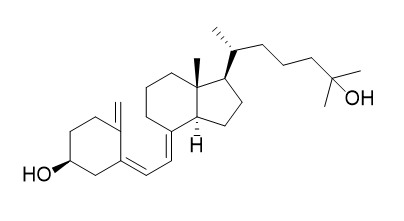
25-Hydroxycholecalciferol monohydrate
25-Hydroxycholecalciferol supplementation at higher doses improved growth performance and decreased inflammatory gene IL-1β mRNA amounts in the liver post-LPS injection.
Inquire / Order:
manager@chemfaces.com
Technical Inquiries:
service@chemfaces.com
Tel:
+86-27-84237783
Fax:
+86-27-84254680
Address:
1 Building, No. 83, CheCheng Rd., Wuhan Economic and Technological Development Zone, Wuhan, Hubei 430056, PRC
Providing storage is as stated on the product vial and the vial is kept tightly sealed, the product can be stored for up to
24 months(2-8C).
Wherever possible, you should prepare and use solutions on the same day. However, if you need to make up stock solutions in advance, we recommend that you store the solution as aliquots in tightly sealed vials at -20C. Generally, these will be useable for up to two weeks. Before use, and prior to opening the vial we recommend that you allow your product to equilibrate to room temperature for at least 1 hour.
Need more advice on solubility, usage and handling? Please email to: service@chemfaces.com
The packaging of the product may have turned upside down during transportation, resulting in the natural compounds adhering to the neck or cap of the vial. take the vial out of its packaging and gently shake to let the compounds fall to the bottom of the vial. for liquid products, centrifuge at 200-500 RPM to gather the liquid at the bottom of the vial. try to avoid loss or contamination during handling.
The Catharanthus Genome2022,35-83.
Cells.2024, 13(14):1229.
J Biochem Mol Toxicol.2022, e23211.
Molecules.2020, 25(20):4851.
J. Mater. Life Sci.2024, 3:2:78-87
bioRxiv2021, 458409.
Asian Pac J Cancer Prev. 2020, 21(4):935-941.
FASEB J.2019, 33(8):9685-9694
Environ Toxicol.2024, tox.24246
J.the Korean Socie. Food Sci.&Nut.2023; 52(1):26-39.
Related and Featured Products
Poult Sci. 2014 Aug;93(8):1951-6.
25-Hydroxycholecalciferol supplementation improves growth performance and decreases inflammation during an experimental lipopolysaccharide injection.[Pubmed:
24931970 ]
Three experiments were conducted to study the effects of 25-hydroxycholecalciferol (25-Hydroxycholecalciferol monohydrate )supplementation on BW gain, IL-1β, and 1α-hydroxylase mRNA expression in different organs of broiler chickens following a lipopolysaccharide (LPS) injection.
METHODS AND RESULTS:
In experiment I, birds were fed a basal diet supplemented with either cholecalciferol (3,000 IU/kg) or 25-hydroxycholecalciferol (69 µg/kg). At 21 and 35 d of age, birds were injected with LPS. Post-LPS injection, birds supplemented with 25-hydroxycholecalciferol gained approximately 2.5% (P = 0.03) and 3.8% (P < 0.01), respectively, more BW than the birds supplemented with cholecalciferol over the 24-h period. In experiment II, birds were fed basal diets supplemented with 25-hydroxycholecalciferol at 6.25, 25, and 50 µg/kg of feed or cholecalciferol at 250 IU/kg of feed. At 35 d of age, birds were injected with LPS. Birds fed 25-hydroxycholecalciferol at 25 and 50 µg/kg and injected with LPS had approximately 7-fold and 3-fold less (P = 0.010) IL-1β mRNA in the liver compared with those birds fed 6.25 µg/kg of 25-hydroxycholecalciferol and the cholecalciferol (250 IU/kg) group. In experiment III, birds were fed a basal diet supplemented with either cholecalciferol (3,000 IU/kg) or 25-hydroxycholecalciferol (69 µg/kg). At 28 d of age, birds were fed 25-hydroxycholecalciferol and injected with LPS had 1.1-fold less (P < 0.01) IL-1β mRNA in the liver than the cholecalciferol-fed group. After an LPS injection, birds supplemented with 25-hydroxycholecalciferol had increased 1α-hydroxylase mRNA amounts in the liver (P = 0.07).
CONCLUSIONS:
In conclusion, 25-hydroxycholecalciferol supplementation at higher doses improved growth performance and decreased inflammatory gene IL-1β mRNA amounts in the liver post-LPS injection.
Biochemical and Biophysical Research Communications, 1980, 95(1):177-181.
Isolation and identification of 25-hydroxy-24-oxocholecalciferol: A metabolite of 25-hydroxycholecalciferol[Reference:
WebLink]
A metabolite of 25-hydroxycholecalciferol(25-Hydroxycholecalciferol monohydrate
) has been isolated in pure form from chicken kidney homogenates.
METHODS AND RESULTS:
It has been identified as 25-hydroxy-24-oxocholecalciferol by means of ultraviolet absorption spectrophotometry, mass spectrometry, infrared spectrometry, nuclear magnetic resonance spectrometry, and specific chemical reactions.
J Agric Food Chem. 1979 May-Jun;27(3):650-2.
25-Hydroxycholecalciferol in cow milk as determined by high-performance liquid chromatography[Reference:
WebLink]
METHODS AND RESULTS:
A high-performance liquid Chromatographic (LC) procedure was developed for the determination of 25-hydroxycholecalciferol (25-Hydroxycholecalciferol monohydrate,25-OH-D3) in cow milk. The procedure involved extraction with an ethanol-ether mixture, a set of solvent partitions, adsorption chromatography on silica gel, a partition chromatography on diatomaceous earth support, and final determination by reversed-phase LC on a C18 bonded microparticulate silica column using a 254-nm fixed wavelength detector. The method was quantitative at the 10-ppb level and capable of detection at the 2-3-ppb level.
CONCLUSIONS:
The method was applicable to milk and colostrum. The endogenous level of 25-OH-D3 in the milk was below the detection limit. It was very significant that, even in cows whose serum concentrations were elevated fivefold after treatment with 25-OH-D3, the concentration in the milk was below the detection level.